"Machine learning" is one of the most used and least understood phrases in technology today. Strip away the hype, and it describes something fairly simple in concept: instead of a programmer writing explicit rules for every situation, a machine learning model is shown a large number of examples and learns the patterns in that data well enough to make predictions on new, unseen examples.
Traditional Programming vs. Machine Learning
| Traditional Programming | Machine Learning |
|---|---|
| Programmer writes explicit rules | Model learns rules/patterns from data |
| Input + Rules → Output | Input + Output (examples) → Rules (the model) |
| Works well for well-defined logic | Works well for fuzzy, pattern-based problems (images, language, behavior) |
The Basic Learning Process, Step by Step
- Collect data - gather a large set of examples relevant to the problem (e.g. thousands of emails labeled "spam" or "not spam").
- Prepare the data - clean it, handle missing values, and convert it into a numerical format the model can actually process.
- Split the data - divide it into a training set (used to teach the model) and a test set (kept aside to honestly evaluate it afterward).
- Choose a model - pick an algorithm suited to the problem (e.g. a decision tree, a neural network, a linear regression model).
- Train the model - the model makes predictions on the training data, compares them to the real answers, measures how wrong it was (the "loss"), and adjusts its internal parameters to reduce that error. This repeats thousands of times.
- Evaluate the model - test it on the data it has never seen before, to check whether it actually learned general patterns rather than just memorizing the training examples.
- Deploy and monitor - put the model into a real product, and keep monitoring its real-world performance, since data patterns change over time.

The Three Main Types of Machine Learning
- Supervised learning: the model learns from labeled examples (input paired with the correct answer) - e.g. spam detection, image classification.
- Unsupervised learning: the model finds hidden patterns or groupings in data that has no labels at all - e.g. customer segmentation, anomaly detection.
- Reinforcement learning: the model learns by trial and error, receiving rewards or penalties for its actions - e.g. game-playing AI, robotics.
Real-World Applications Students Already Use Every Day
Spam filtering: email providers like Gmail use models trained on huge volumes of labeled spam and legitimate email to automatically filter unwanted messages, continuously retraining as spam tactics evolve.
Voice assistants: tools like Siri and Google Assistant rely on machine learning models for speech recognition (converting audio to text) and natural language understanding (figuring out what you actually meant).
What Neural Networks Add to the Picture
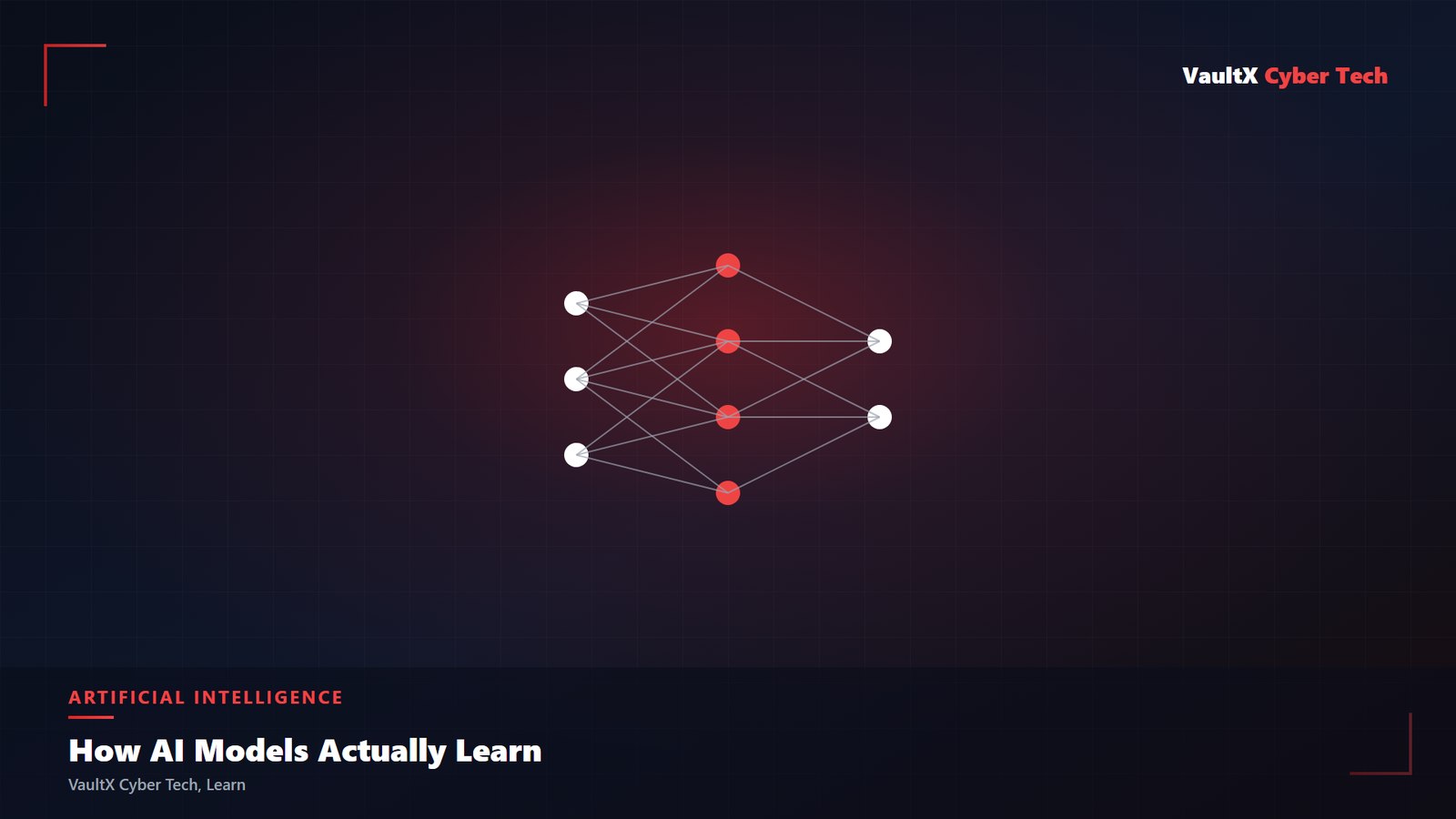
A neural network is a specific type of machine learning model loosely inspired by how neurons connect in the brain - layers of simple mathematical units that each learn to detect increasingly complex patterns. "Deep learning" simply refers to neural networks with many layers stacked together, which is what powers most of today's most capable AI systems, from image recognition to large language models.
Why This Matters for Students
- Machine learning is now embedded in nearly every modern software product - understanding the basics is quickly becoming as fundamental as understanding databases or networking.
- You don't need to be a math genius to start - a solid grasp of Python, basic statistics, and the workflow above is enough to begin building real, working projects.
- Employers increasingly value people who understand both the technology and its real limitations - knowing what a model can't do is as valuable as knowing what it can.
Key Takeaways
- Machine learning lets a model learn patterns from data instead of being explicitly programmed with rules.
- The core workflow is: collect data, prepare it, train a model, evaluate it honestly, and deploy it.
- Overfitting - memorizing instead of generalizing - is one of the biggest practical challenges in real ML systems.
- Recommendation engines, spam filters, and voice assistants are real, everyday products built on these exact principles.