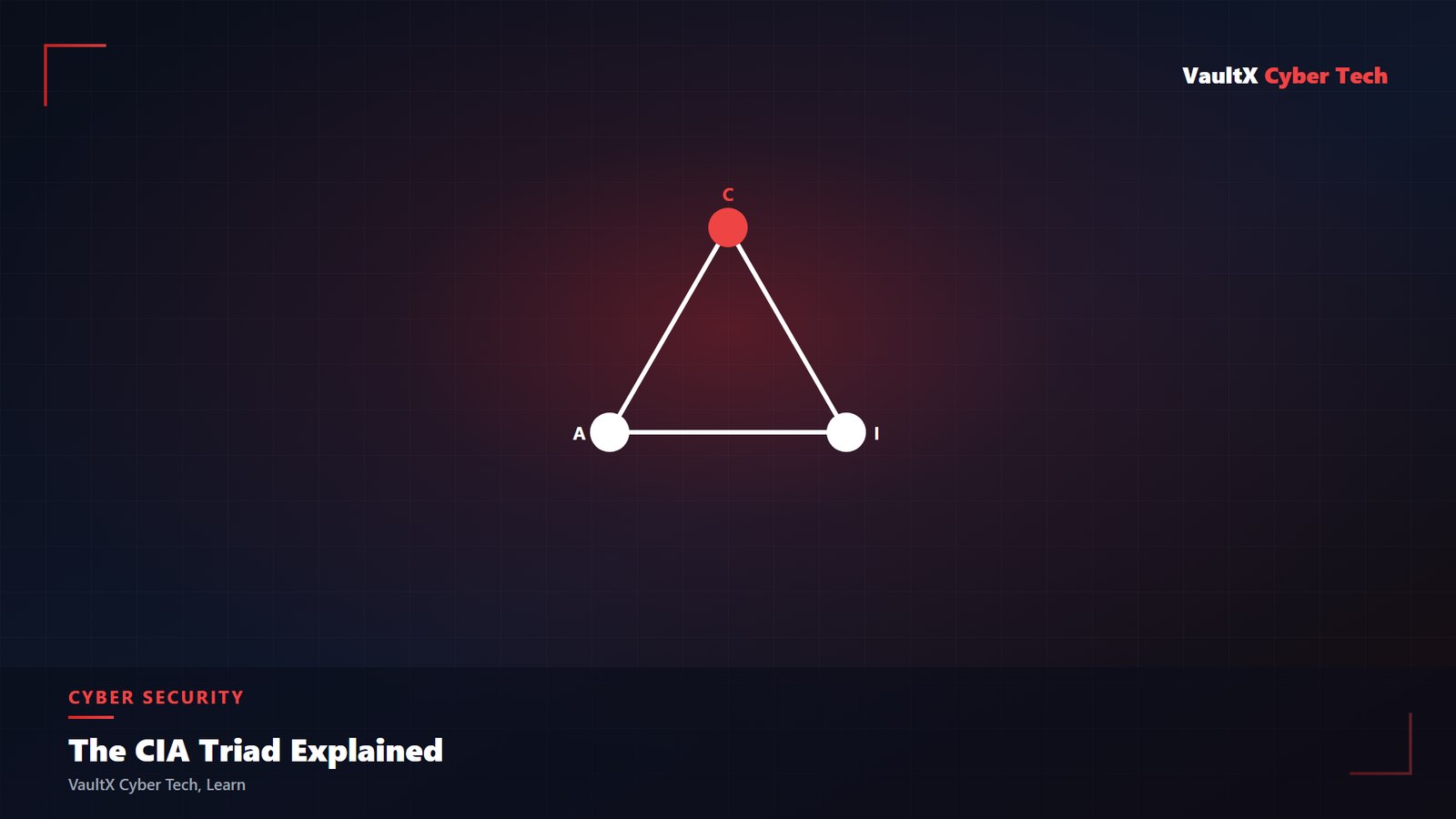
If you ask a working security professional to justify almost any control - encryption, backups, access permissions, monitoring - the reasoning eventually traces back to three words: Confidentiality, Integrity, and Availability, known together as the CIA Triad. It's the single most foundational model in the entire field, and every certification from Security+ to CISSP starts here for a reason.
What the CIA Triad Actually Means
Integrity - the data is accurate and hasn't been tampered with.
Availability - the data and systems are accessible to authorized users when needed.
Every security incident you will ever study can be classified as a failure of at least one of these three pillars - and most major breaches are actually a failure of more than one at once.
Confidentiality: Keeping Data Away From the Wrong People
Confidentiality controls stop unauthorized parties from reading data they shouldn't see - encryption, access control lists, authentication, and the principle of least privilege all exist to protect this pillar.
Integrity: Making Sure Data Hasn't Been Tampered With
Integrity is about trustworthiness of data - making sure a file, transaction, or message is exactly what it claims to be, with nothing silently altered along the way. Hashing, digital signatures, checksums, and version control all protect this pillar.

Availability: Keeping Systems Up and Reachable
Availability means systems and data are accessible to the people who legitimately need them, when they need them. Redundancy, backups, DDoS protection, and disaster recovery planning all exist to protect this pillar.
Why Trade-offs Between the Three Are Constant
In the real world, these three pillars are frequently in tension with each other, and security professionals have to balance them rather than maximize all three at once:
- Stronger confidentiality (e.g. mandatory multi-factor authentication on every action) can slow down availability and usability.
- Strict integrity checks (e.g. requiring manual sign-off on every data change) can slow down how quickly systems stay available and responsive.
- Maximizing availability (e.g. keeping systems always reachable from anywhere) can widen the attack surface and weaken confidentiality.
Good security design isn't about picking one pillar - it's about matching the right balance to what the specific system actually needs to protect.
Key Takeaways
- The CIA Triad - Confidentiality, Integrity, Availability - is the foundational model behind almost every security control that exists.
- Confidentiality failures (Twitter 2020), integrity failures (SolarWinds 2020), and availability failures (Colonial Pipeline 2021) are all real, well-documented, and each teaches a different lesson.
- Most serious breaches fail more than one pillar at once.
- Every security decision - a firewall rule, a backup schedule, an access permission - should be traceable back to which of these three pillars it's protecting.